
Off Page SEO for Small Businesses: Link Building That Builds Trust, Not Pressure
If you’ve ever wished Google could “just see” how honest your business is, you’re not alone. Most of us pour our hearts into our websites, then wonder why traffic feels slow. Here’s the quiet truth: off page SEO for small businesses is less about polishing your pages and more about what the internet says about you when you’re not in the room.
Think of it like word-of-mouth at church. People recommend what they trust. Online, those “recommendations” show up as links, mentions, reviews, and shares. This is a long obedience in the same direction, not a quick trick.
In this post, you’ll learn:
- 🔗 How backlinks, mentions, and reviews work together to build online trust
- 🌿 What makes a link worth earning (and what’s not worth your energy)
- 🤝 Relationship-first link building ideas that feel aligned with your faith
- 🗓️ A simple 30-day plan to start earning strong links without burnout
What matters most off your website, links, mentions, and trust signals
Off-page SEO is everything that happens outside your website that helps search engines trust you. If on-page SEO is your “home,” then off-page SEO is your “reputation in the neighborhood.”
Here are the main pieces, in plain language:
Backlinks are clickable links from other sites to yours. They’re like referrals.
Brand mentions are times people talk about your business online, with or without a link.
Citations and directories are listings that repeat your business info, especially for local searches.
Reviews are public feedback, often tied to buyer trust and local visibility.
Social sharing spreads your content, and it can lead to mentions and links over time.
What matters in 2026 is what’s hard to fake. Search engines keep getting better at spotting manufactured “authority.” That’s why relationship-based visibility wins. If you want a helpful snapshot of how modern off-page factors fit together, this off-page SEO checklist for 2026 lines up with what many small businesses are seeing right now.
Google tends to reward trust signals that look like real life:
- ✅ Relevance (the sites talking about you make sense for your niche)
- 👣 Real traffic (people actually click and engage, not just bots)
- 🌱 Consistency (steady growth beats random spikes)
- 🧾 Credibility (clear identity, honest reviews, accurate business info)
When your off-page signals come from real relationships, your rankings stop feeling like a roller coaster.
Backlinks explained without jargon, what makes a link worth earning
It’s tempting to treat link building like collecting stamps. More is better, right? Not anymore. One good link can outweigh dozens of weak ones, because quality carries context.
A strong backlink usually has four traits:
It’s relevant. A link from a business coach directory or women’s entrepreneurship blog fits better than a random coupon site.
It’s earned editorially. Someone chose to reference you because your content helped them.
It sends real people. You might see clicks, email signups, or even DMs that mention the article.
It’s placed naturally. The link sits inside a meaningful paragraph, not a weird list of unrelated sites.
You’ll also hear about anchor text, which is simply the words people click. For example, “free business starter guide” is anchor text. Keep it natural. If every link uses the same exact phrase, it looks forced.
If you’re curious how link building is shifting (without the gimmicks), this overview of link building in 2026 echoes the same theme: fewer shortcuts, more substance.
Brand mentions and reviews, the quiet signals that still move the needle
Sometimes the internet will “talk about you” without linking to you. A podcast host mentions your name. A newsletter recommends your free guide. A client tags you on Instagram. Those unlinked mentions still matter because they reinforce that your business exists and people recognize it.
This is also where consistent business info becomes a form of trust. Your name, address (if applicable), phone number, and website should match across the web. If you’re service-based and remote, you can still keep your branding and contact details consistent wherever you show up.
Then there are reviews. Reviews do two things at once: they help buyers feel safe, and they add proof for search engines, especially for local searches and map results.
A kind way to ask for reviews (without getting pushy):
- 💛 Ask right after a win (a result, a breakthrough, a smooth onboarding)
- ✍️ Make it simple (two questions they can answer in a few lines)
- 🙏 Give them an out (“No pressure, only if you feel comfortable”)
- 🌿 Thank them either way (because relationships matter more than ratings)
If your work serves local clients too, don’t ignore local trust signals. Even a single community mention can carry weight. This local SEO in 2026 overview highlights how much business profiles, reviews, and consistent info still shape visibility.
Link building that feels aligned, relationship first strategies that work
 Healthy link building looks like steady bridges, not a scramble, created with AI.
If link building has ever made you cringe, you’re in good company. “Can you link to me?” can feel like showing up empty-handed. Instead, think of links as the byproduct of partnership.
When you lead with service, you stop chasing attention and start building a web of mutual support. It’s not unlike bringing a meal to someone who’s had a hard week. You show up with something real, and the relationship deepens naturally.
Practical strategies that tend to work well for online business owners in 2026:
- 🤝 Partner content (guest trainings, interviews, summit swaps)
- 🎙️ Podcasts and newsletters (your story plus one clear takeaway)
- 🧩 Resource page placements (being listed as a helpful tool)
- 🏡 Local and niche listings (only the ones with real standards)
- 🪴 Community involvement (events, charities, workshops with a web page)
This is also why off-page SEO isn’t just “get links.” It’s a trust system. The best summary I’ve read lately is this piece on off-page SEO techniques that still work in 2026, especially the warning about tactics that look impressive in a spreadsheet but do nothing for real customers.
Guest posting and podcast pitching, turn your story into authority
Guest posting and podcast interviews work because they borrow trust the right way. You’re not borrowing someone’s audience to sell. You’re borrowing a moment to serve.
First, pick targets with real people behind them. Look for signs like fresh posts, real comments, active email lists, and episode recency. Then choose topics that match what their audience already cares about.
A simple pitch outline usually includes:
A warm, specific compliment, one sentence that shows you know their audience, 2 to 3 topic ideas, and one proof point (a short story, a result, or a helpful resource).
A few gentle guardrails:
- ✅ Do: offer a practical teaching angle, a testimony, or a case study
- ✅ Do: link to one helpful resource on your site, not five sales pages
- ✅ Do: follow up once, politely, after a week
- ❌ Don’t: pitch huge sites that don’t fit your niche at all
- ❌ Don’t: make it about you only, make it about their listeners
- ❌ Don’t: force exact-match anchor text, keep link text natural
Resource pages, broken links, and directory listings that are actually worth it
Resource pages are exactly what they sound like: curated lists of helpful tools, guides, and references. Many bloggers, churches, nonprofits, and associations maintain them. If you have a strong freebie or a genuinely useful article, you can ask to be included.
Broken link building is similar, but with a kindness-first angle. You find a page that links to an old or missing resource, then you let the site owner know. If you have a solid replacement, you offer it. The goal isn’t to “score a link,” it’s to help them fix something for their readers.
You can find opportunities by searching for phrases like “resources,” “helpful links,” “recommended tools,” plus your niche. Keep it simple.
Directories are where many people waste money. Some are fine. Many exist only to sell you a listing and never send traffic.
Signs a directory is legit:
- 🧭 Real moderation (not instant approval for anything)
- 🎯 Niche or local focus (not “every business on earth”)
- 👀 Visible traffic signals (active site, real categories, recent updates)
- 🚫 No spam overload (if every listing looks fake, leave it)
If you need a starting point for local link ideas, Moz has a solid list of local link building tactics that can spark ideas without pushing shady shortcuts.
A simple 30 day plan to earn your first strong links (without burnout)
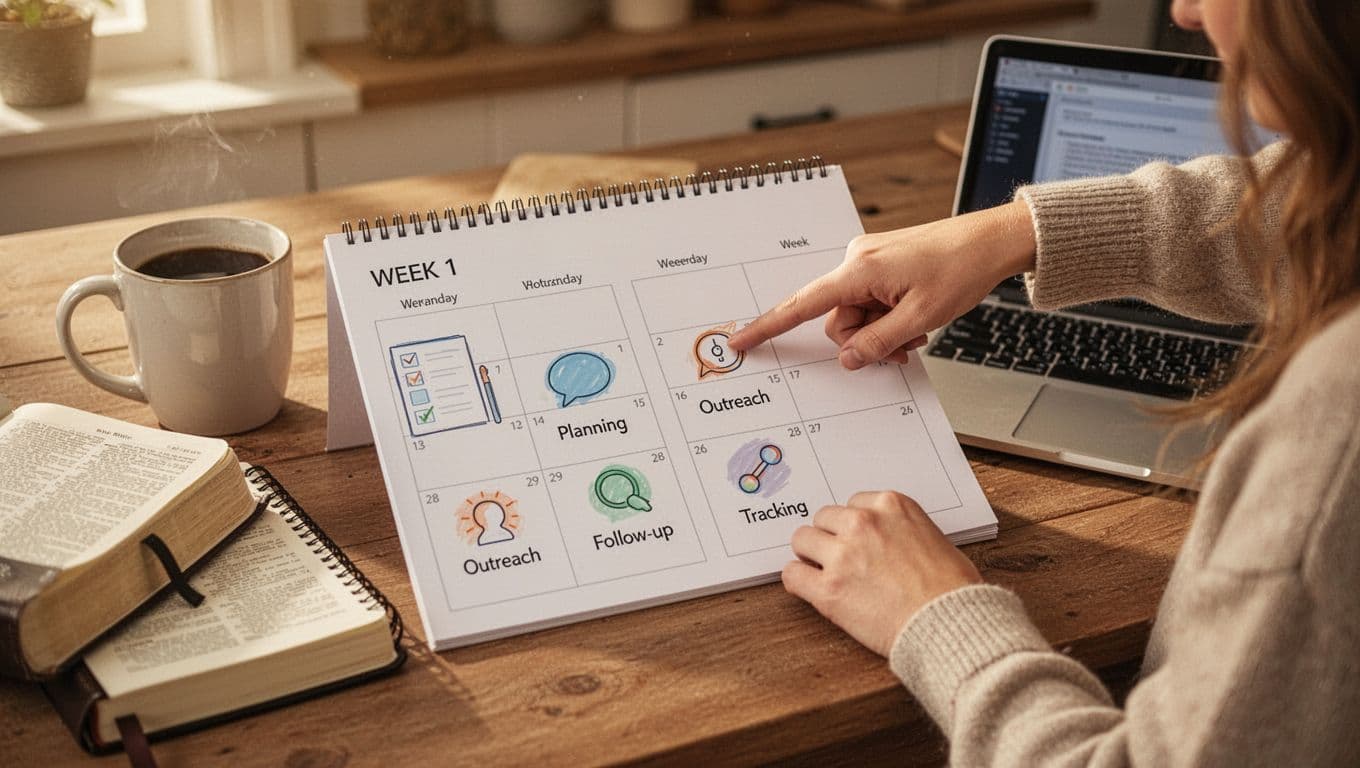 Small steps on a real schedule can build steady off-page growth, created with AI.
If you’re running a business, managing a home, and trying to keep your spirit tended, you don’t need an intense plan. You need a gentle one that works. Set aside 30 to 45 minutes, a few days a week. That’s enough to build momentum.
A realistic goal is 5 to 10 solid links per month once you get moving, with quality first. Some months you’ll get fewer links but better connections. That still counts.
Here’s a simple month plan:
- 🗓️ Week 1: choose one link-worthy asset, list 25 places it fits
- 🔍 Week 2: research contacts, listen or read, then personalize your outreach
- ✉️ Week 3: send pitches (8 to 12), track them, and keep it prayerful, not frantic
- 🔁 Week 4: follow up once, say thank you, and note what worked
The secret is steadiness. Off page SEO for small businesses tends to reward the businesses that keep showing up.
Create one link worthy asset, then repurpose it everywhere
You don’t need 20 new freebies. You need one strong asset that genuinely helps your people.
Ideas that fit faith-based online business owners:
A free starter guide, a simple checklist, a mini training, a set of templates, or even a devotional-style reflection that ties business growth to biblical wisdom (with practical steps, not just encouragement).
Once it exists, repurpose it with intention. Turn it into:
A guest post angle, three podcast talking points, short answers in relevant forums, and a handful of short social posts that point back to the same helpful resource.
This is how one piece of work becomes many seeds. You plant once, then water it in several places.
Track what is working and avoid mistakes that can hurt you
You don’t need fancy tools to start. You need a few signals that tell the truth.
Watch for:
Referral traffic (are people clicking from the sites that mention you?)
Rankings (slow changes over weeks, not hours)
Brand searches (more people searching your business name)
New mentions (even without links)
Google Search Console is a free place to monitor search clicks and queries. Pair that with a simple spreadsheet where you track outreach dates and results.
Also, keep an eye out for red flags:
- 🚩 Paid link schemes that promise quick ranking boosts
- 🚩 Link farms and spammy guest post networks
- 🚩 Weird anchor text that doesn’t match normal language
- 🚩 Sudden spikes in backlinks you didn’t earn
- 🚩 Irrelevant sites that have nothing to do with your audience
Conclusion: Trust wins, and it grows the honest way
 Progress feels quieter than hype, and it’s worth celebrating, created with AI.
Off-page SEO can sound technical, but it’s really about trust. Links, mentions, and reviews are public signs that your business serves real people. When you build those signals through relationships, your marketing starts to feel lighter.
AI is changing how we work in 2026. It can help you find opportunities and personalize outreach faster. At the same time, search engines are better at spotting fake links and recycled fluff. That’s why authentic mentions, real partnerships, and consistent trust signals matter more than ever.
Next steps to keep it simple:
- 🌿 Pick one tactic you’ll stick with for 30 days
- 🕰️ Set a weekly outreach block, even if it’s just 30 minutes
- 📌 Track results and stay steady, because faithful work compounds over time